
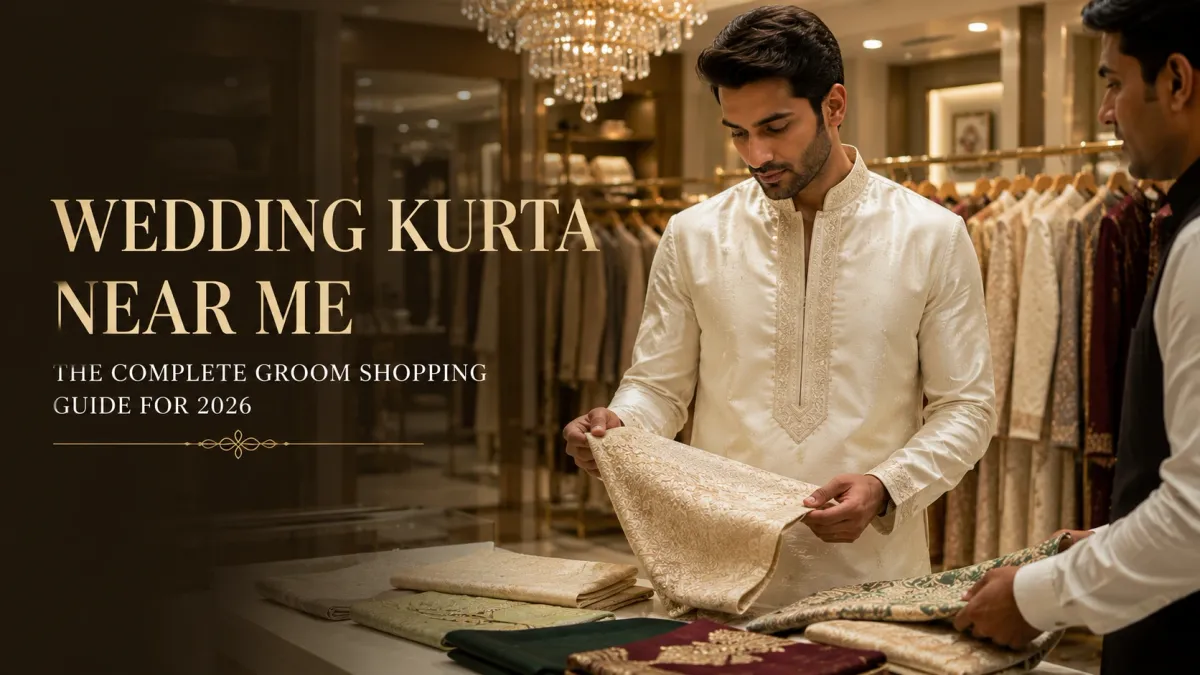
The 2026 Wedding Kurta Guide for Men: Outfits, Fabrics & Local Styling
Finding a wedding kurta near you is the easy part. The harder part — and the part most grooms wish they had thought about earlier — is knowing exactly what you're looking for before you walk into a showroom.
This guide walks you through the full decision: occasion, fabric, fit, coordination, and where to shop in Delhi and Chhattisgarh. Work through it in order and you'll walk into any showroom knowing what to ask.
Step 1: Decide which events you're dressing for
Most grooms need more than one look. Before you think about colour or fabric, map out your events. Wedding week typically breaks into three dressing moments, each with different requirements.
Pre-wedding events: Mehndi, Haldi, and Sangeet
These are high-energy events — you'll be sitting cross-legged, dancing, and hugging a hundred people. Heavy embroidery and stiff silks are the wrong call here.
For Mehndi and Haldi, lean toward cotton-silk kurtas in mustard, marigold, turmeric yellow, or soft olive. They're breathable, easy to move in, and photograph well under daylight. For Sangeet, you have more creative room — printed Chanderi, textured linen-silk blends, or a kurta with a subtle Nehru jacket in a contrast tone all work well.
The main ceremony: Pheras or Nikah
This is where the investment piece lives. For the primary ceremony, comfort still matters — you'll be standing and moving for hours — but this is also the look that anchors every photograph. A Tussar or pure silk kurta with restrained hand-embroidery at the collar, cuffs, and placket is the most versatile choice. It reads formal in photos, stays breathable in person, and holds its shape through a long ritual.
Avoid over-embellished sherwanis unless your venue and ceremony type genuinely call for it. Many grooms find them restrictive and regret the choice by hour three.
Reception
The reception gives you the most freedom. This is where you can try a bolder colour — deep burgundy, forest green, midnight navy — or experiment with a longer kurta-jacket combination. Since you're mostly greeting guests rather than performing rituals, you can afford slightly heavier fabrics and more decorative detailing.
Step 2: Match the fabric to the season and venue
Fabric is the single decision that most affects how comfortable you'll be on the day. Here's a practical breakdown:
Tussar silk is the best all-rounder for main ceremonies. It's less shiny than pure silk, has a natural texture that photographs beautifully, and handles heat better than you'd expect.
Pure silk (Banarasi or plain weave) is rich and formal but can feel heavy in summer weddings or outdoor mandaps. Best suited for winter ceremonies or air-conditioned banquet halls.
Jamawar is a woven fabric with intricate patterns built into the weave rather than embroidered on top. It has weight and presence without the stiffness of heavy embroidery. Pastel Jamawar — ivory, sage, dusty rose — has become the dominant formal choice in 2026 for grooms who want traditional craft without looking overdressed.
Cotton-silk and Chanderi blends are your friends for daytime or outdoor pre-wedding events. They drape well, don't cling when you sweat, and come in the kinds of saturated colours that work under natural light.
Silk-linen blends sit between formal and relaxed. Good for Sangeet or mehfil-style receptions where you want some formality without the weight of pure silk.
Step 3: Get the fit right — this is where most grooms cut corners
Standard sizes don't account for how individual bodies actually sit, stand, and move. A kurta that fits perfectly on a hanger can pull across the shoulders when you raise your arms during pheras, bunch at the waist during the baraat, or gap at the collar when you bow your head.
When you go in for a fitting, check these four things:
- Shoulder seam: Should sit exactly at the shoulder point, not dropping onto the arm.
- Chest: Enough room to breathe deeply and raise both arms without pulling.
- Kurta length: For ceremony wear, mid-thigh to just above the knee is the standard. Too long reads as shapeless; too short looks casual.
- Sleeve opening: Should allow easy movement. Tight sleeve openings are the most common complaint on the wedding day.
Custom tailoring solves all of this — but it requires time. Book your first fitting appointment at least six to eight weeks before the wedding, not two. Alterations after the first fitting take another one to two weeks.
Step 4: Coordinate with the bridal look before you finalise anything
Matching doesn't mean wearing the same colour. It means the two of you look like you dressed for the same occasion. Before you commit to a kurta, bring a swatch or a clear photo of the bridal lehenga or saree — the base colour, the embroidery thread colour, and the border.
A few principles that work:
- Tonal coordination (soft gold kurta with a cream-and-gold lehenga) always photographs well.
- Contrast coordination (ivory or off-white kurta against a deep red or fuchsia bridal look) is clean and classic.
- Avoid competing embroidery. If the bridal outfit has heavy zardozi work, your kurta's embellishment should be understated — and vice versa.
Most good showrooms will help you coordinate on the spot if you bring the reference.
What's trending in 2026
Two directions are defining groom looks this season:
Asymmetric hemlines and built-in texture. Rather than layering a heavy stole over a plain kurta, more grooms are opting for kurtas with textured weaves, subtle pintucks, or slightly angled hemlines. The effect reads as considered rather than costume-y, and it removes the need for an uncomfortable stole entirely.
Pastel Jamawar in place of embroidered sherwanis. Ivory, sage green, dusty mauve, and powder blue Jamawar kurtas — worn with churidar or straight-cut trousers — have largely replaced the heavily embroidered sherwani for grooms who want to look formal without feeling overdressed. The fabric does the work; the silhouette stays clean.
Where to shop near you
Delhi
White Hanger Pitampura is the right stop if you want custom tailoring or have a specific design brief. Book a weekday morning appointment if you want one-on-one time with the tailors — weekend slots fill up fast closer to the season.
White Hanger at Omaxe Mall, Chandni Chowk is better if you want to browse a curated ready-to-wear selection in a comfortable environment. Being in Chandni Chowk means you're also in the centre of Delhi's wedding market — useful if you want to compare before committing.
Chhattisgarh
White Hanger Raipur (Pandri Market) carries the widest range of traditional silks and Jamawar in Central India. If you're particular about fabric and want to handle multiple options, this is the place.
White Hanger Bilaspur offers the same range for grooms who don't want to make the trip to Raipur. The selection is curated for the Bilaspur market without compromising on quality.
Outside these cities? Book a Video Shopping Appointment — a consultant will walk you through the current collection live over a call.
Common questions
Which kurta works best for the main ceremony?
Tussar silk or pure silk with hand-embroidery at the collar and cuffs. Restrained embellishment photographs better than heavy work under mandap lighting. If you want more presence, choose a richer colour over heavier embroidery.
What's a realistic budget for a wedding kurta in Delhi?
A well-made custom kurta-pyjama set in a mid-range silk fabric starts around ₹8,000–₹15,000. Heavier Jamawar or hand-embroidered Banarasi silk sets typically run ₹18,000–₹35,000 and above. Tailoring cost is usually included when bought in-store.
How early should I start shopping?
Six to eight weeks before the wedding for custom work. Ready-to-wear can be picked up in two to three weeks, but if you need alterations — and most grooms do — build in extra time.
Can I bring the bride's outfit swatch for coordination?
Yes, and you should. Any White Hanger consultant can help you match or contrast against the bridal look. Even a clear photograph of the bridal outfit on your phone is enough to work with.
Ready to start? Visit your nearest White Hanger showroom or book a video appointment if you're outside Delhi or Chhattisgarh.